
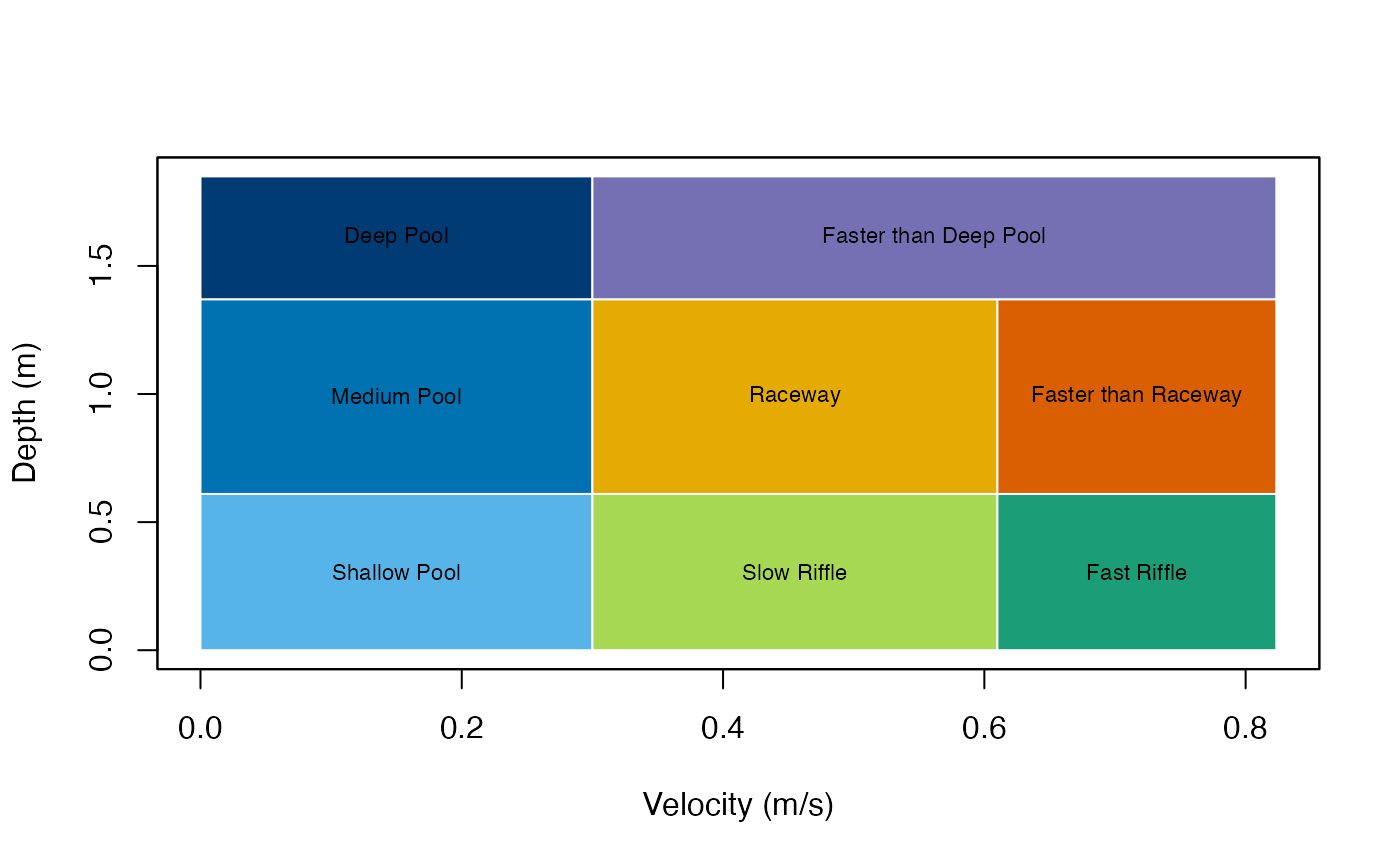
The default eight-class scheme implements the depth and velocity thresholds used by Cordero and Harris (Preprint), with the broader depth-velocity mesohabitat framework informed by Aadland (1993). Cordero and Harris define the exact eight rows implemented by the package, including “Faster than Raceway” and “Faster than Deep Pool.”
Aadland studied fish assemblages, habitat-use and habitat-preference guilds, and habitat relationships with flow in six Minnesota streams. The original paper describes six types: shallow pool, slow riffle, fast riffle, raceway, medium pool, and deep pool. It does not present the package’s exact eight-row SI table, and the package does not attribute the two added high-velocity labels to Aadland.
The output is a hydraulic classification based on depth and velocity alone. It does not establish habitat quality or species occupancy. Biological interpretation can depend on species, life stage, stream type, substrate, cover, connectivity, water quality, temperature, flow regime, and local field validation. Raster results also inherit hydraulic-model, terrain, boundary condition, calibration, and resolution uncertainty. Alignment or interpolation can move cells across sharp class thresholds.
Users must document how dry cells are encoded. The default
dry_threshold = NULL preserves the mathematical scheme,
including Class 1 for zero depth and zero velocity. Classifying median
hydraulic surfaces is not the same as taking the modal class through
time. Class IDs are identifiers, not ecological ranks.
References
- Cordero, E. and Harris, A. (Preprint). Semi-Supervised and
Supervised Machine Learning Approaches to Predicting Fluvial
Mesohabitats from Satellite Data. SSRN. DOI:
10.2139/ssrn.7100727. - Aadland, L. P. (1993). Stream Habitat Types: Their Fish Assemblages
and Relationship to Flow. North American Journal of Fisheries
Management, 13(4), 790–806. DOI:
10.1577/1548-8675(1993)013<0790:SHTTFA>2.3.CO;2.