
Custom interpolation functions
custom-interpolation.RmdA custom function is called exactly as
fun(points, template, grid). It must return either a
SpatRaster matching the template or one numeric value per
template cell. The following plane is intentionally simple: it
demonstrates the interface, not a scientific recommendation.
planar_method <- function(points, template, grid) {
  stopifnot(
    inherits(points, "SpatVector"),
    inherits(template, "SpatRaster"),
    is.data.frame(grid),
    identical(names(grid), c("X", "Y")),
    nrow(grid) == ncell(template),
    "Z" %in% names(values(points))
  )

  xy <- as.data.frame(crds(points))
  names(xy) <- c("X", "Y")
  xy$Z <- values(points)$Z
  if (nrow(xy) < 3 || any(!is.finite(xy$Z))) {
    stop("The planar example needs at least three finite observations.")
  }

  fit <- lm(Z ~ X + Y, data = xy)
  prediction <- predict(fit, newdata = grid)
  stopifnot(is.numeric(prediction), length(prediction) == ncell(template))
  prediction
}
data("synthetic_wells", package = "potentiomap")
points <- ps_make_points(
  synthetic_wells, "x", "y", "gw_elevation", "well_id", "EPSG:26916"
)

surface <- ps_interpolate(
  points,
  methods = "planar",
  custom_methods = list(planar = planar_method),
  grid_res = 100,
  mask = ps_sample_aoi(),
  padding = 0
)$planar

data.frame(
  class = class(surface)[1],
  rows = nrow(surface), columns = ncol(surface),
  x_resolution_m = res(surface)[1],
  finite_cells = global(surface, "notNA")[[1]]
)
#>        class rows columns x_resolution_m finite_cells
#> 1 SpatRaster   29      36            100          904
plot(surface, col = hcl.colors(64, "RdYlBu", rev = TRUE),
     main = "Custom planar example — not a recommended model")
plot(points, add = TRUE, pch = 21, bg = "white")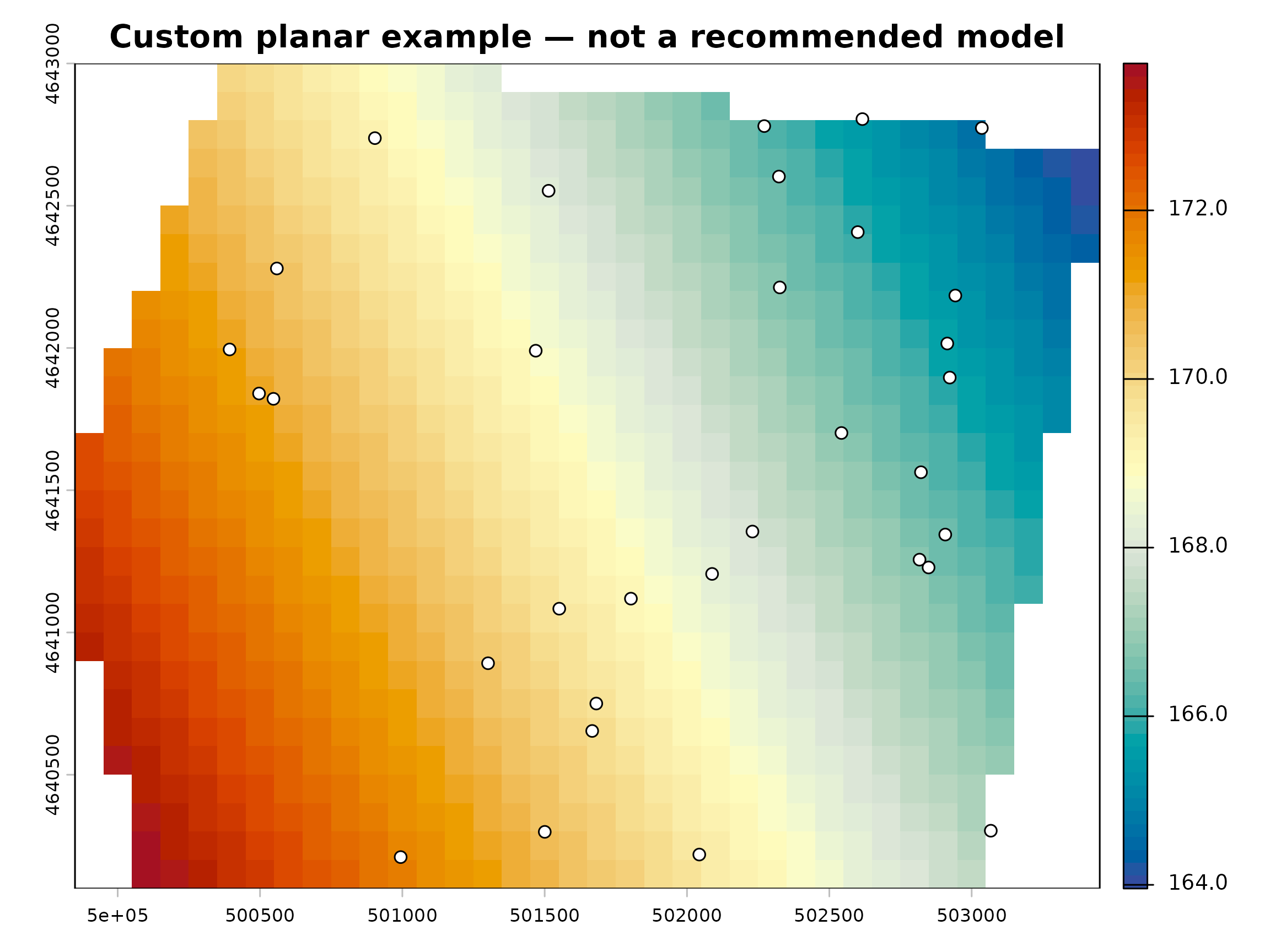
expected <- rast(crs = crs(points), ext = ext(ps_sample_aoi()), resolution = 100)
data.frame(
  same_crs = same.crs(surface, expected),
  x_resolution_m = res(surface)[1],
  y_resolution_m = res(surface)[2],
  masked = global(is.na(surface), "sum")[[1]] > 0
)
#>   same_crs x_resolution_m y_resolution_m masked
#> 1     TRUE            100            100   TRUE
For a production custom method, add method-specific diagnostics,
parameter records, unit tests, and validation. Do not rely on
potentiomap::: internals; the documented function signature
is the stable public boundary.